Fibromyalgia is not a diagnosis. It is a description. And nobody is telling you the difference.

She pressed her hands against the cold kitchen counter at 3 AM because the cold was the only thing that interrupted the humming for a few seconds.
Not pain exactly. Not the kind you can point to. Something underneath. A low, constant vibration in every muscle and every joint, all day, every day, like somebody had plugged her into a wall socket and walked away.
Her husband stopped asking if she was okay. He just started making tea.
Her name does not matter for this story. What matters is that she is one of roughly ten million people in the United States alone who have been given a word — fibromyalgia — and told to treat it like an answer.
It is not an answer. It is a description.
A diagnosis explains why something is happening. It points to a mechanism. A cause. Something you can address.
A description tells you what is happening. Widespread pain. Sleep disruption. Cognitive difficulty. Sensitivity to touch. That is all fibromyalgia is. A clinical term for a pattern of symptoms grouped under a label. It describes what the body is doing. It does not explain why.
The difference between those two things has cost millions of people years.
Years of medications that manage symptoms without touching the cause. Years of doctors who write "chronic condition, no cure, continue management plan" in charts and move to the next patient. Years of waking at 2 AM with every nerve firing into the dark and being told to consider whether the problem might be anxiety.
The word was never the problem. The problem is that the word replaced the question nobody asked.
What is actually happening inside the cell.
What doctors are saying about fibromyalgia when nobody is recording

There is a private medical forum. The kind of place where physicians post under pseudonyms and say what they would never say in an exam room with a chart open and a patient sitting in front of them.
Over the past two years a thread titled "Are we failing fibromyalgia patients systemically?" has collected over three hundred responses from neurologists, rheumatologists, functional medicine practitioners, and pain specialists across four countries.
The posts read differently than anything you will hear in a fifteen minute appointment.
"Fibromyalgia is not a disease. It is a billing code. It describes what is happening but explains nothing about why. And we keep prescribing around the description instead of investigating the mechanism."
"Classic presentation. NMDA receptors locked open. Intracellular magnesium depleted under chronic cortisol load. Prescribing gabapentin on top of duloxetine on top of a muscle relaxer. We are treating the smoke. Nobody is looking at the fire."
"The standard serum magnesium test measures one percent of total body magnesium. One percent. We are using the wrong ruler and telling patients they are fine. And then we wonder why they come back worse every year."
"Had a patient on pregabalin for five years. Pain unchanged. Sleep worsening. Checked intracellular magnesium on a hunch. Severely depleted. Started bisglycinate at 400mg. By week eight she used a word I had not seen in her chart in five years. Improving."
"I switched fourteen patients to pure bisglycinate over six months. Twelve reported measurable improvement by day ninety. Not one reported improvement on the oxide they had been taking before. The form is the variable. It has always been the form."
Then a reply that has been shared across three separate threads:
"The tragedy is not that we do not know this. The research exists. The tragedy is that it sits in journals nobody reads while we continue prescribing downstream interventions that muffle the signal without ever closing the gate."
Three hundred posts. Not one defending the current standard of care.
What is actually happening inside your cells when everything hurts

A pain signal is not a substance. It is not something floating through blood. It is an electrical event. It happens at a junction between two nerve cells. And the switch that controls whether that signal fires or stays quiet is a receptor called NMDA.
In a healthy nervous system, NMDA receptors open when there is a real reason to feel pain and close when the danger passes. Open. Close. Like a gate.
In fibromyalgia, the gates are stuck open.
Not metaphorically. Physically. The NMDA receptors in nerve cells are locked in the open position. Every signal fires. Every nerve responds. The brain receives pain data from the shoulders, knees, hands, back — all at once, all the time, whether there is actual tissue damage or not.
That is what central sensitization means. It means the nerves are overly sensitive. What it does not explain is why they are stuck.
The molecule that closes the NMDA gate is magnesium.
The body uses magnesium to shut the receptor down after a pain signal fires. When the body is under chronic stress — and pain is the most potent form of chronic stress there is — it produces cortisol. Cortisol burns through magnesium. Low magnesium means the gates stay open. Open gates mean more pain. More pain means more cortisol. More cortisol means less magnesium.
It is a loop. And nothing in a standard fibromyalgia medicine cabinet touches the loop.
Here is the part that changes how you understand every medication you have ever been prescribed for this condition.
Pregabalin. Gabapentin. Duloxetine. Amitriptyline. Cyclobenzaprine. Every one of these works downstream. They intercept the pain signal after it has already fired. They sedate the nervous system to quiet the noise. They muffle the alarm after the alarm has already gone off.
They drug the entire house to fix one room. And the room still is not fixed.
Magnesium bisglycinate works upstream. It closes the gate before the signal fires. It does not muffle the pain. It removes the reason the pain is firing in the first place.
Downstream: the signal fires, the drug dampens it, the gate stays open, the loop continues.
Upstream: the mineral reaches the receptor, the gate closes, the signal stops at the source.
Different drugs. Same hole in the bucket. That is downstream.
One mineral. At the gate. Before the signal. That is upstream.
This is not a theory. The research has been published in peer reviewed journals for over a decade. The connection between magnesium depletion, NMDA receptor dysfunction, and central sensitization in fibromyalgia patients is documented.
The question is not whether the science exists. The question is why nobody told you.
Why your blood work says you are fine while your body is screaming
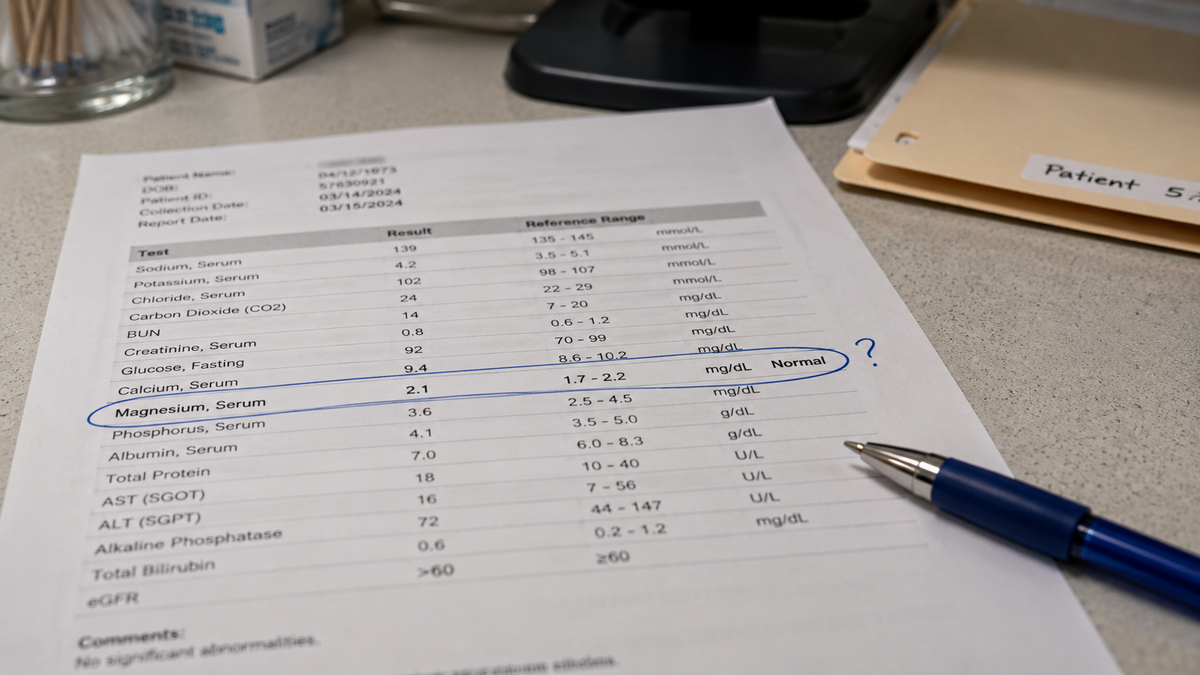
Every fibromyalgia patient has heard this sentence: "Your labs look normal."
It is technically true. And it is profoundly misleading.
The standard magnesium test measures serum magnesium. Serum is the liquid part of blood. It contains one percent of the total magnesium in the body.
One percent.
Ninety nine percent of magnesium is inside cells. Bones. Muscles. Nerve tissue. The places where pain signals fire and NMDA receptors open and close. The places where fibromyalgia actually lives.
A serum test tells a doctor almost nothing about what is happening at the cellular level. Blood can read perfectly normal while every cell in the body is starving for the one mineral that controls whether the gates stay open or close.
Dr. Elena Vasquez, a board certified neurologist with twenty one years of clinical practice, has been vocal about this problem in professional settings for the past decade.
"Serum magnesium is the test we run because it is the test we have always run. It is cheap. It is fast. Insurance covers it. And it measures the wrong compartment."
"I have had patients sit across from me with serum magnesium of 2.1 — textbook normal — while presenting with every clinical marker of severe intracellular depletion. Pain in every joint. Sleep architecture destroyed. Cognitive function declining. NMDA receptors firing continuously."
"The test is not wrong. It is simply not measuring what matters. And the difference between what is easy to measure and what actually matters has cost my patients years."
This is not a fringe concern. A growing body of literature on magnesium testing acknowledges that serum levels do not reliably reflect intracellular status. The test that would measure what matters — an RBC magnesium or intracellular magnesium assay — exists. Most doctors have never ordered it. Most patients have never heard of it.
Every year, millions of fibromyalgia patients get blood work done. Their doctor scans the results. Magnesium reads normal. The chart note says: continue current management plan.
And the cells keep starving.
The bottle you already tried was designed to fail
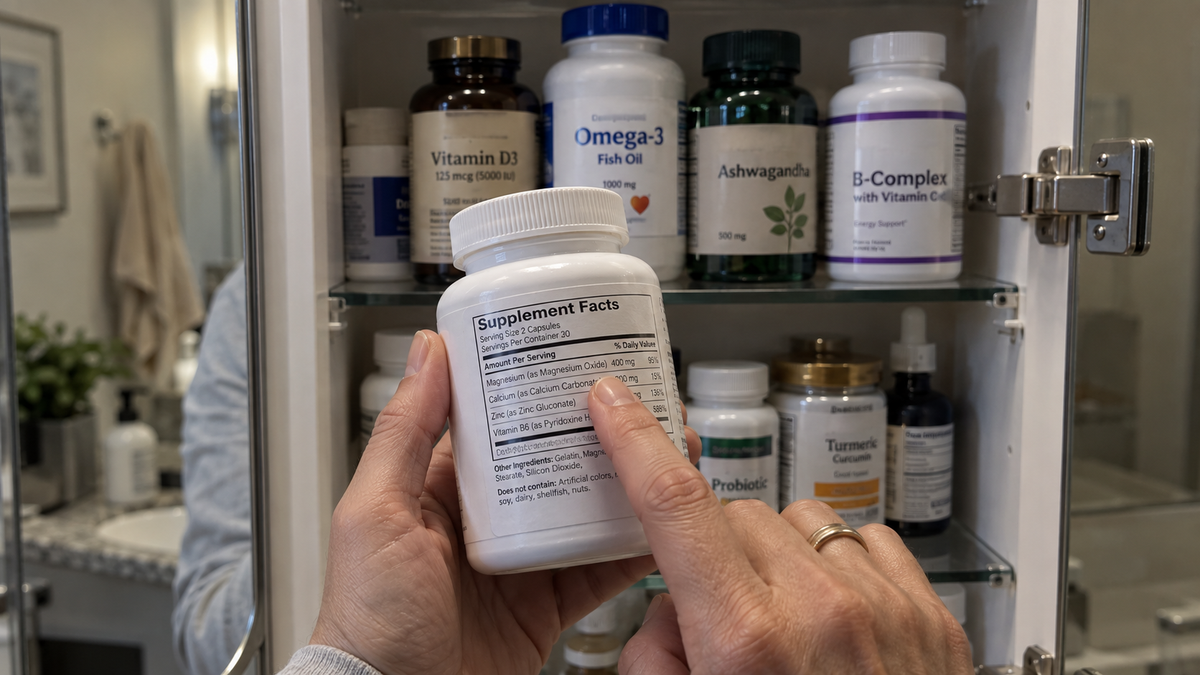
Most fibromyalgia patients have tried magnesium at some point. Most of them quit within three weeks.
The reason they quit is not that magnesium does not work. The reason they quit is that the product they bought was engineered to be cheap, not to be absorbed.
Walk into any pharmacy. Pick up any bottle with the word magnesium on the front. Flip it over. Read the ingredients on the back. The tiny print they buried there on purpose.
In eight out of ten of those bottles, the back label says magnesium oxide.
The front says magnesium. The back says oxide. And the company that made it knows — knows — that the human body absorbs roughly four percent of magnesium oxide.
Four percent.
The other ninety six percent sits in the gut. Draws water into the intestines. Causes bloating, cramping, diarrhea. Then passes straight through.
That is not magnesium failing. That is the wrong form of magnesium doing exactly what the wrong form of magnesium does.
It gets worse. Some bottles say "Magnesium Glycinate" on the front. Turn them over. The back says "Magnesium Glycinate Buffered with Magnesium Oxide." Buffered is industry code for "we stuffed the capsule with cheap oxide filler and hoped nobody would check."
These are not small startups making honest mistakes. These are billion dollar companies with scientists on payroll and legal departments engineering every word on the label to mislead without technically breaking the law.
Oxide costs fractions of a penny per dose. The form that actually absorbs costs ten times more. And that is all it took.
Every woman who has said "I tried magnesium and it did nothing" was almost certainly taking oxide. She did not fail magnesium. The product failed her. And then she stopped looking. And her NMDA receptors stayed open. And her pain got worse. And her doctor added another drug to the stack.
Because nobody told her to flip the bottle over.
Go check yours. Right now. The bottle in your cabinet. The one you gave up on.
If it says oxide, that is why nothing happened.
The form your nervous system has been waiting for
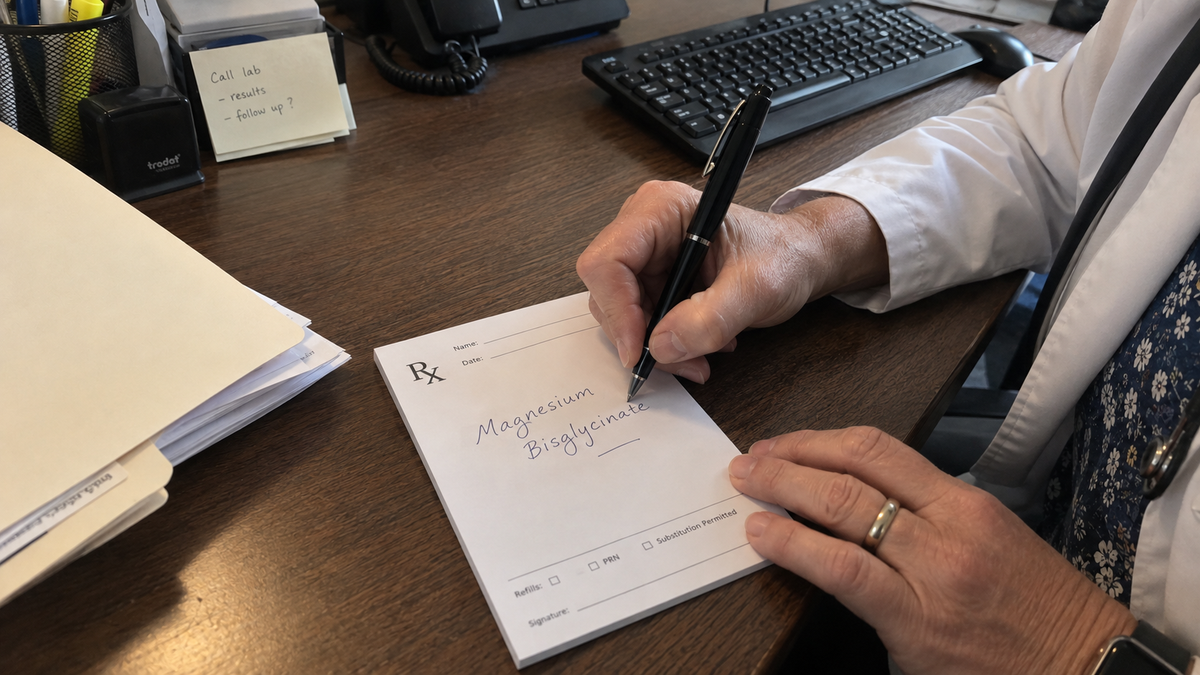
The form that the research supports, that the doctors on those forums are switching their patients to, and that changes the equation at the receptor level is magnesium bisglycinate.
Not oxide. Not citrate. Not a "complex" with oxide hidden behind a glycinate label.
Bisglycinate.
Here is what makes it fundamentally different from everything else on the shelf.
Bisglycinate is magnesium bound to two molecules of glycine. The glycine acts as a shield. It protects the magnesium through the digestive system and delivers it directly into cells. Not the bloodstream. Not the gut. The cell itself.
The body absorbs up to ninety percent of bisglycinate. Not four percent. Ninety.
But the glycine is not just a carrier. Glycine is an inhibitory neurotransmitter. It works directly on NMDA receptors — the same receptors that are stuck open in fibromyalgia.
The magnesium reaches the cell. The glycine reaches the receptor. Together they do the one thing that years of downstream medication have not done.
They close the gate.
That is all it does. It is not a painkiller. It is not a sedative. It is not a drug that suppresses the nervous system into silence. It is the raw material your body was designed to use — fire when there is danger, and stop when there is not.
The difference between downstream and upstream in one sentence: your medication quiets the house after the alarm goes off. Bisglycinate turns off the alarm.
Why 90 days changes everything and 9 days changes nothing

The body did not become depleted overnight. It took years. Possibly a decade. Chronic pain pumping cortisol through the system, burning through magnesium faster than any diet could replace it. Medications that never addressed the loop. A test that measured the wrong compartment. An industry that sold the wrong form.
Restoring that deficit does not happen in a week. It does not happen in one bottle. It happens when magnesium reaches the cell, stays there, and accumulates long enough for NMDA receptors to begin responding to a gate signal they have not received in years.
The people who report the biggest changes stay consistent for ninety days.
Most of them almost quit after week two. Not because it was not working. Because the body does not send a notification when it is healing at the cellular level. It just quietly starts functioning again.
Week 1 to 2. Glycine begins calming NMDA receptors. The pain does not vanish. It shifts. The humming drops in volume. Sleep onset improves — falling asleep becomes easier, even if 2 AM wake ups still happen. The mornings feel slightly different. The stiffness releases a few minutes earlier than usual. Not dramatic. Noticeable.
Week 3 to 4. Magnesium stabilizes at the cell level. The cortisol loop that has been spiking every night weakens. 2 AM wake ups become less frequent. Morning stiffness shortens — from forty five minutes to twenty. Hands close around a coffee mug and they stay closed. The body starts doing things it has not done in years without announcing it. You notice, and you do not mention it to anyone because you are afraid to trust it.
Week 5 to 8. The nervous system shifts from survival mode to restoration. Deep sleep increases. The fog lifts. Concentration returns. The ability to read a full article or hold a conversation without losing the thread comes back. Physical confidence shifts — standing up from a chair without bracing. Walking through a grocery store without holding the cart for balance. Saying yes to an invitation without calculating whether the body will cooperate.
Week 9 to 12. Full protocol. The people who reach this point describe the same thing. Not feeling medicated. Not feeling sedated. Feeling like themselves. The version they lost three, five, seven years ago. The one who carried things without thinking. The one who did not negotiate with her own body every morning before getting out of bed.
They describe it with one word more than any other.
Quiet.
Not the absence of pain. The quiet. The moment when the humming stops and the nervous system goes from a scream to a whisper and the first thing they feel in the morning is not their body working against them but their body being theirs again.
That is why the guarantee is 90 days. Not 30 days like brands that know their oxide will fail before the month ends.
90 days. Nothing changes, every penny back. One email. No questions.
The product that matches the protocol

Celuvida Magnesium Bisglycinate Gummies.
One product. One form. Nothing else in the formula that does not need to be there.
✅ 100% Pure Bisglycinate. Up to 90% absorption. No oxide. No citrate. No buffered blends. No "magnesium complex" hiding the wrong form behind the right word.
✅ 400mg Per Serving. The dose used in clinical studies on magnesium and fibromyalgia. Not the 100mg of oxide on most shelves. Two gummies. Full clinical dose.
✅ Glycine Delivery. The amino acid bound to the magnesium is not just a carrier. It is an inhibitory neurotransmitter that works directly on NMDA receptors. The same receptors that are stuck open. It does not just deliver the mineral. It closes the gate.
✅ Zero Stomach Problems. Absorbs into cells, not the gut. No bloating. No cramps. No diarrhea. The first magnesium you will not quit after three weeks because your stomach could not handle it.
✅ Third Party Tested. Every single batch. Purity. Potency. No heavy metals. No hidden oxide. Results published. Because if a company will not show you independent testing, they know what the test would find.
✅ Sugar Free. Vegan. Non GMO. Raspberry flavor. Sixty gummies per bag. Thirty day supply. Less than one percent return rate.
✅ 90 Day Money Back Guarantee. Every penny back if nothing changes. One email. No questions asked. No product return required. Because a company that stands behind its product for 90 days is a company that knows what happens at day 90.
What people with fibromyalgia are saying after 90 days

Sandra H., 53, former elementary school librarian.
"Seven doctors in seven years. All of them gave me the same word. Not one of them told me what was actually happening inside my cells. By week two on Celuvida I got out of bed and walked to the bathroom without stopping. I stood there and stared at myself because I could not remember the last time I had done that. Just stood up. And walked. Without bargaining with my own body first. By week six I went to my granddaughter's birthday party and stood in the kitchen for three hours frosting cupcakes. My daughter turned away and wiped her eyes."
Donna M., 58, former dental hygienist.
"Eighteen years. That is how long I had fibromyalgia before anybody told me about the gate. Gabapentin, duloxetine, a muscle relaxer. Still woke up every morning feeling beaten. My chiropractor mentioned bisglycinate. I found Celuvida. By week three the morning stiffness was half what it had been. By week eight I stopped bracing myself before standing up from a chair. My doctor wrote the word improvement in my chart for the first time in eighteen years."
Rachel P., 51, teacher.
"I told my husband I was done trying supplements. Done. He ordered Celuvida without telling me. I took them because they tasted like candy and I was too tired to argue. Two weeks later I slept through the night. Three weeks later the humming in my legs stopped. Five weeks later I stood at the stove and cooked a full dinner for the first time in two years. My husband stood in the doorway watching. He did not say anything. He did not have to."
Marta K., 46, diagnosed at 38.
"My rheumatologist told me fibromyalgia was chronic and the goal was management. I accepted that for eight years. Management meant three medications and a life that got smaller every year. I stopped going to my book club. Stopped driving at night. Stopped picking up my nephew because I was afraid my hands would not hold. Four weeks on Celuvida and I picked him up. My sister watched me and started crying. She said she had not seen me do that in three years."
What this is not

This needs to be said clearly.
Magnesium bisglycinate is not a cure for fibromyalgia. It is a mineral. It addresses one specific mechanism — the NMDA gate — by restoring the raw material the body needs to close it.
It does not work for everyone.
If your cells are not depleted, you will not feel a dramatic shift. If your pain has a structural cause — an injury, a compressed disc, nerve damage from surgery — magnesium will not repair that structure. If you are not under chronic cortisol load, the depletion loop may not apply to you.
One customer's sister started taking Celuvida after watching the transformation. Ten weeks in, she noticed nothing. She is healthy. She sleeps eight hours. She has never stood in a parking lot afraid to bend her knees.
That is not a failure of the product. It is confirmation that the product works at the level of the problem, not as a blanket sedative that makes everyone feel something whether they need it or not.
If you have spent years under chronic pain. Under cortisol load. Under medications that never touched the loop. Under a test that measured the wrong compartment. If your body hums. If your muscles burn without injury. If your joints ache and your doctors call it managed.
Your cells are almost certainly depleted. And the 90 day protocol exists specifically to give your body enough time to prove it — or to get every penny back if it does not.
Nobody is asking you to believe a stranger on the internet. Start, stop, or change nothing about your current medications without talking to your prescribing physician. This is not a replacement for medical care. It is the mineral your medical care forgot to check.
Two choices. One keeps you exactly where you are.

Choice 1: You close this page.
Tonight you take the same medications. You wake at 2 AM. Heart pounding. Body humming. Brain firing into the dark. The medications muffle the signal downstream. The gate stays open upstream. The loop repeats.
Tomorrow you lower yourself out of bed the way you lower yourself into a bathtub. Testing every joint. Negotiating with your knees. Spending forty five minutes becoming a person who can walk to the kitchen.
Next month someone invites you somewhere and you calculate whether your body will cooperate for two hours before deciding. You say "I would love to but" and they hear the but and they stop asking.
Six months from now the word on your chart is still the same. The management plan is still the same. The ceiling at 2 AM is still the same.
Choice 2: You start the 90 day protocol.
Thirty seconds. Click below. Most people start with the three bag bundle because they understand that a decade of depletion does not reverse in one month.
Tonight you take two gummies after dinner.
This week the humming drops one notch. You notice it at 2 AM. Not gone. Quieter.
This month your morning stiffness shortens. Your hands close around a mug and stay closed. Someone in your house notices before you say anything.
Ninety days from now you are standing somewhere you stopped going. A kitchen. A birthday party. A grocery store parking lot. And the first thing you feel when you wake up in the morning is not pain.
It is the quiet.
Not the absence of symptoms. The quiet. The moment when the humming stops. When the nervous system goes from a scream to a whisper. When you wake up and the first thing you feel is not your body fighting you but your body being yours again.
A woman who went through this described it simply: "I wanted to tell a stranger in a parking lot what the quiet sounds like. I could not. Because you do not walk up to someone and tell them that the word their doctor gave them is not an answer."
"But I wanted to."
The quiet sounds like picking up a grandchild without fear. Like reading sixty pages of a novel without losing the thread. Like someone reaching for your hand and you letting them hold it because it does not hurt.
That is what the quiet sounds like.
And you deserve to hear it.
→ Start the 90 day protocol. Every penny back if nothing changes.
Celuvida Magnesium Bisglycinate Gummies
- Recommended by Neurologists
- Proven, Safe & Natural Ingredients
- Trusted by 50,000+ Happy Customers
- 90 Day Risk Free Guarantee
Try it today. If nothing changes in 90 days, every penny back. One email. No questions.
Recommended Product: